
Training and capacity building
We train people at every step of the food chain, from farmers and extension agents to processing staff, chefs and dieticians.
Modules cover climate-smart farming, business planning, customer discovery and digital logistics.
Taught in the group's own language. Sessions run in English, French or the local language, whichever the group works in.
Workshops for farmer groups
On-site and regional workshops for farmer-based organisations, cooperatives and agricultural networks.
Climate-smart agriculture
Practices that cope with erratic weather, such as drip irrigation, cover cropping and better crop choice.
Group marketing
How a group sells together: pooling produce, agreeing prices and dealing with buyers.
Financial literacy and cooperative governance
Keeping accounts, managing group funds and running a cooperative with clear rules and elected leaders.
Crop protection and value chain inclusion
Safe pest control, and how smallholders can supply processors and larger buyers.

How training is arranged
A programme is put together for each group rather than taken off the shelf.
Needs assessment
We meet the group or organisation and agree what people need to learn.
Programme
We put together the modules, schedule and materials, on site or at a regional venue.
Training and follow-up
Trainers run the sessions with practical work, then check in on how it is being applied.

In the field
Most sessions are practical. People learn with their hands on the crop, the machine or the pan.
 Farm skills
Propagation, hands on
Trainees cut and lay yam minisetts in a propagation box they will run themselves.
 Value addition
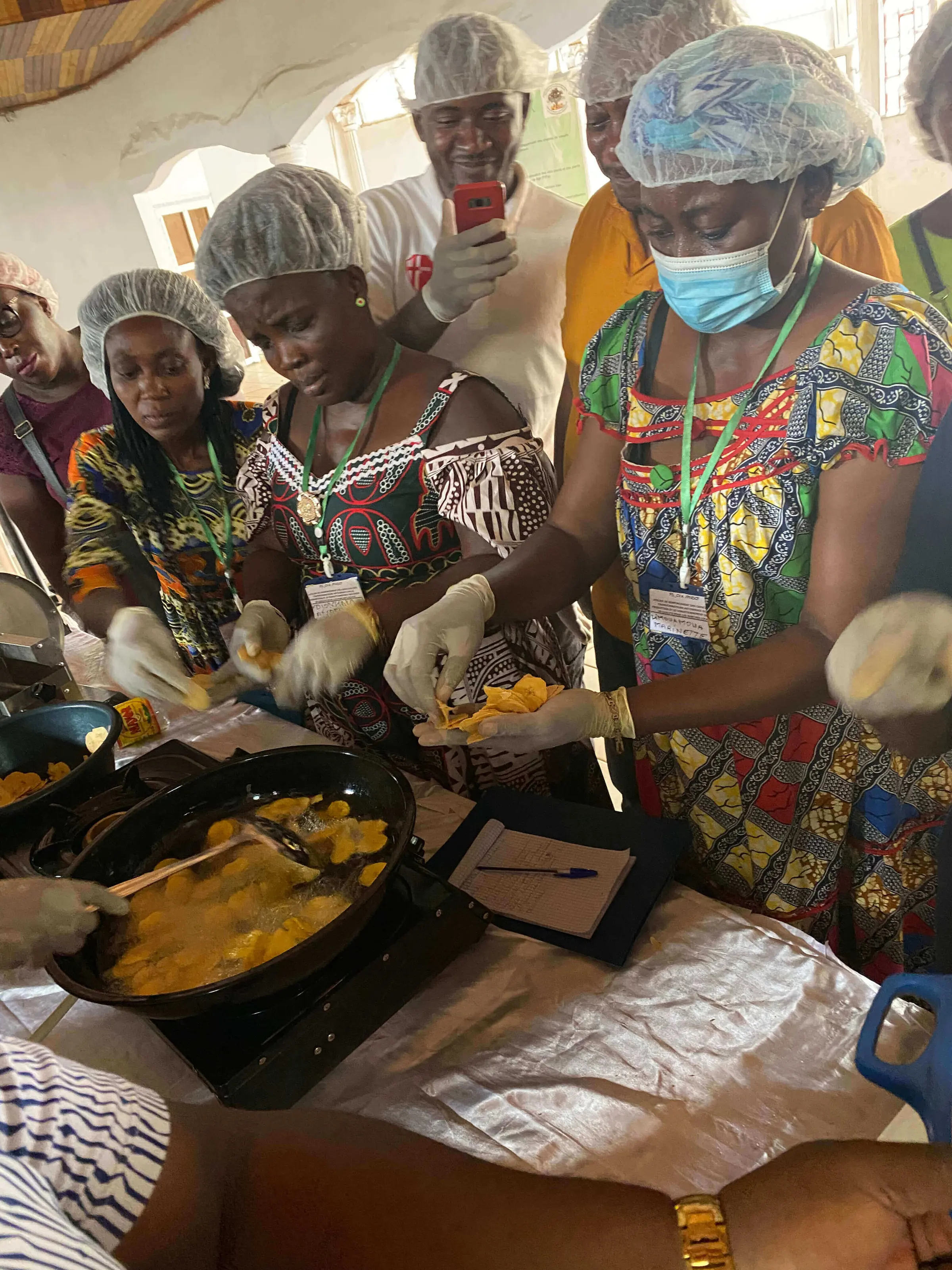
In the training kitchen
Food processing sessions run in hairnets and gloves, to the same hygiene routines as the factory.
 Business skills
Planning and selling
Business planning and customer discovery sessions sit alongside the farm and kitchen work.


Results
Training is built into the programmes we run, so it is measured by what people do afterwards.
Two programmes we run
The Youth Agro-Incubation Programme combines agribusiness coaching, a demonstration farm and mentoring, with hands-on work in plantain, mushroom and snail production. The Women in Food Systems pilot trains women in crop production, processing, quality control and branding, and ends with a business plan competition and a place in our supplier network.

What the work shows
Young cooks into the trade
Young caterers and dieticians are incubated through the ChefPreneur programme at Praïs.
Support for older farmers
Older farmers who have lost productive capacity get free training, starter stock or inputs, and help marketing their harvest.
Food safety on stage
Community drama and workshops teach shoppers the signs of safe, chemical-free food in local markets.

Skills that stay
in the community after we leave
Who we train
Farmer-based organisations
Cooperatives and farmer groups, trained on site or at regional workshops.
Organisations and programmes
Agriculture training for NGOs, companies and public bodies, built around their own projects.
Consultants and interns
Young agri-consultants and interns who learn alongside our field and factory teams.
Quick answers
Do you come to us, or do we come to you?
Either. We run workshops on site, in the community or at the farm, and regional sessions that bring several groups together.
Is the training free?
Our programmes for young people and women are free or subsidised. For organisations, we quote each programme after the needs assessment.
Can graduates train with you?
Yes. Graduates in agriculture, food science, logistics and business join our teams, learn on the job with mentoring from our specialists, and can be placed with our partners.
Do you train staff on new processing machines?
Yes. When we install equipment, your staff are trained on food safety, machine use and maintenance as part of the handover.
Related services
Projects rarely need one service on its own. These are the ones most often combined with this one.
 Farms and estates
Farm setup and management
Land scouting, soil tests, farm layout and a crop calendar, then follow-up through the season.
See the service Food businesses
Processing infrastructure
Feasibility, equipment supply, installation and staff training for processing units, plus packaging for small food brands.
See the service Where every project starts
Feasibility study
A site and market assessment before any money goes into planting, buildings or machines.
See the service


Train your team with us
Tell us who needs training, in what and in which language, and we will plan the sessions.


